UI / UX Design
Care4U
AI-Powered Healthcare Assistant - Healthcare Prototype App
Year :
2020
Industry :
Health & Technology
Project Duration :
16 weeks

Problem Statement:
Dementia patients and their care networks face a critical disconnect in understanding and managing daily care needs.
Patients with dementia experience cognitive decline that affects their daily functioning, yet often don't understand why these changes are happening to them. Meanwhile, family members struggle to provide appropriate support without constant physical presence, and healthcare professionals lack continuous access to the nuanced data needed to monitor patient wellbeing, both physical and emotional.
This knowledge gap between patients, families, and medical professionals results in:
Patients feeling monitored rather than supported, reducing their sense of independence.
Families experiencing anxiety and uncertainty about their loved one's daily well-being.
Doctors making care decisions based on infrequent snapshots rather than continuous data.
Increased reliance on expensive long-term care facilities that many families cannot afford.
How might we create a supportive monitoring system that preserves patient dignity and independence while giving families peace of mind and doctors the continuous data they need to provide quality care?

Solution Statement:
Care4U is an AI-powered healthcare monitoring system designed to bridge the care gap for dementia patients while preserving their dignity and independence.
The system connects three user groups through a compassionate monitoring platform:
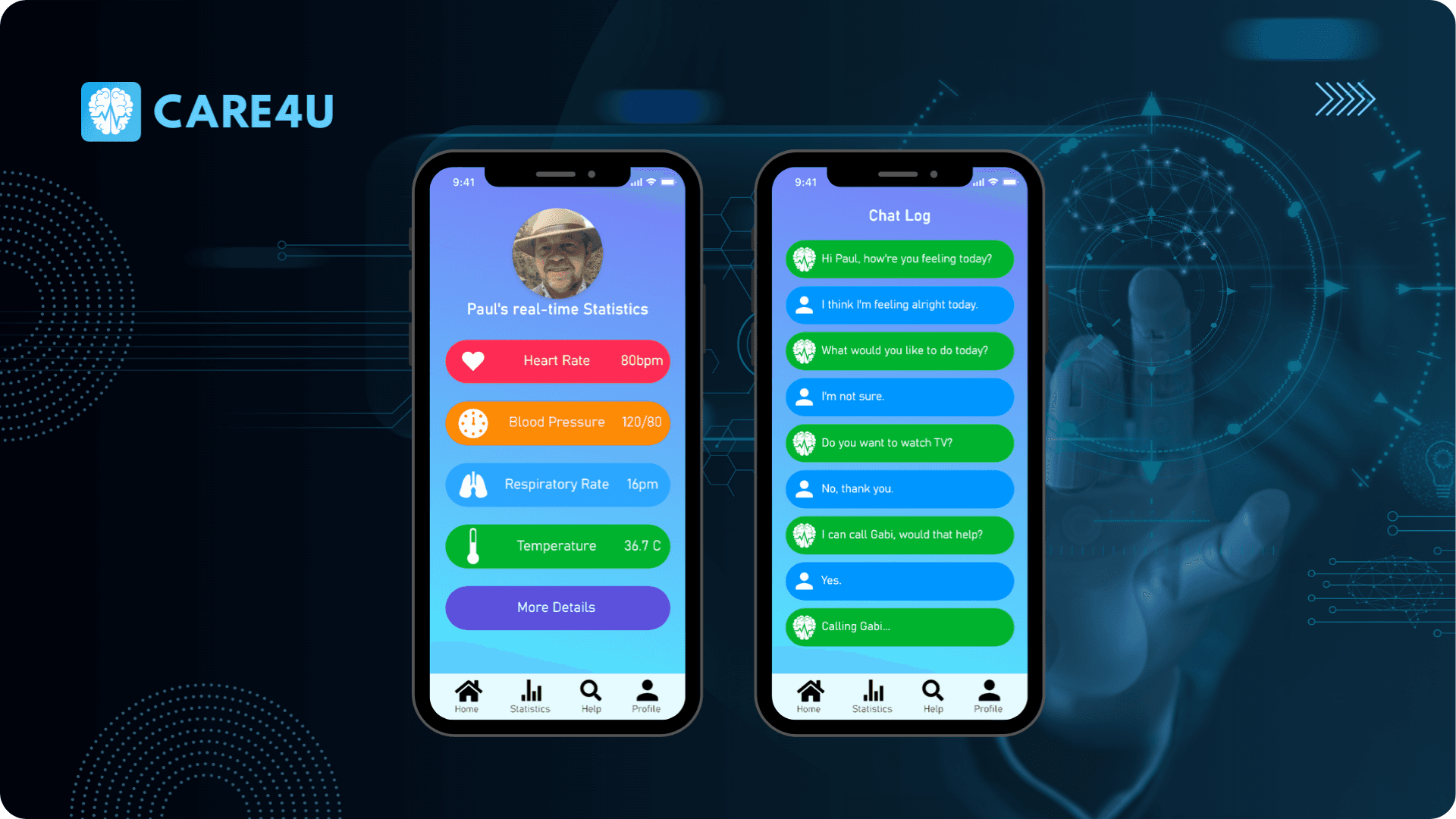
For Patients (Primary Users): An AI companion engages in natural conversations to provide emotional support and mental stimulation. The interface feels like a friendly check-in rather than clinical surveillance, helping patients maintain their sense of autonomy while the system unobtrusively tracks their wellbeing.
For Families (Secondary Users): A simplified dashboard provides real-time access to vital health statistics (heart rate, blood pressure, temperature, mood) and daily activities. Family members can review AI conversations to understand their loved one's emotional state and receive alerts if intervention is needed, all without requiring constant physical presence.
For Healthcare Professionals (Tertiary Users): Doctors gain access to comprehensive, continuous health data that would normally be difficult to collect, including detailed vitals, behavioral patterns, and cognitive engagement metrics. This enables more informed care decisions based on real-time trends rather than periodic check-ups.
By augmenting rather than replacing human connection, Care4U empowers dementia patients to live more independently while ensuring their care network has the information needed to provide timely, appropriate support.
Challenge:
How do you monitor vulnerable dementia patients without making them feel monitored?
Creating Care4U required balancing three competing tensions:
1. Surveillance vs. Dignity The system needed to continuously track physical vitals and cognitive engagement, yet it couldn't feel invasive or clinical. Patients had to feel augmented, not observed, comfortable enough with the technology that their behavior remained natural and measurements stayed accurate.
2. Simplicity vs. Depth Family members needed quick, understandable insights into their loved one's wellbeing, while doctors required granular medical data. The same system had to serve both casual check-ins and clinical diagnostics without overwhelming non-medical users or oversimplifying for professionals.
3. Connection vs. Independence The care network needed visibility into the patient's daily life to provide support and ensure safety, but too much access could infantilize patients and reduce their self-sufficiency. The solution had to enable monitoring while actively promoting patient autonomy.
Additional Constraints:
Addressing significant privacy and consent concerns around sharing personal health data and AI conversations.
Designing for a future technological landscape (implants, advanced sensors) while creating a functional present-day prototype.
Ensuring the solution remained financially accessible as an alternative to expensive long-term care facilities.
Summary:
Project Overview
Care4U began as an ambitious exploration into "Humanizing AI" investigating how artificial intelligence could understand and respond to human emotions in healthcare contexts. Working with teammates Mya Cipparrone and Rebecca Sader during the Winter 2020 semester, we focused our research on dementia care, a field where emotional wellbeing is just as critical as physical health.
My Role: UX/UI Designer & Researcher
As the visual designer and researcher on the team, I was responsible for translating complex healthcare needs into an intuitive, compassionate interface. This involved conducting user research to understand the distinct needs of dementia patients, their families, and healthcare providers, then designing a prototype that balanced clinical functionality with emotional sensitivity.
Collaborative Research & Design Process
Our team worked closely to identify critical knowledge gaps in dementia care. While Mya focused on understanding patient and caregiver needs, and Rebecca explored technical functionality and next-step innovations, I synthesized these insights into user flows and visual designs that felt supportive rather than clinical.
Through iterative design sessions, we made crucial decisions together:
Color palette selection that felt calm and approachable rather than sterile and medical
Information hierarchy that prioritized emotional wellbeing alongside physical vitals
Conversational AI interface that engaged patients naturally without feeling like an interrogation
Differentiated views for families (simplified, reassuring) versus doctors (detailed, diagnostic)
Overcoming Design Challenges
The biggest creative challenge was designing surveillance that didn't feel like surveillance. To solve this, I focused on:
Visual warmth: Using soft colors, friendly typography, and conversational language to make the interface feel like a caring companion rather than a monitoring device.
Progressive disclosure: Showing families just enough information to feel reassured without overwhelming them with clinical data, while giving doctors access to deeper analytics when needed.
Empathetic interactions: Designing the AI chat interface to feel like genuine check-ins ("How're you feeling today grandpa?") that naturally collected data without feeling transactional.
Testing & Iteration
Through multiple testing rounds with the team, we refined the prototype based on how users responded to different visual treatments and interaction patterns. We simplified complex medical information, adjusted the color scheme to be both modern and comforting, and streamlined navigation to ensure family members could quickly check on their loved one's status.
The Result
The final prototype successfully demonstrated how technology could augment independence rather than diminish it, a fully functional proof-of-concept that balanced the needs of three distinct user groups while maintaining the dignity and autonomy of dementia patients at its core.
The Final Prototype
UI / UX Design
Care4U
AI-Powered Healthcare Assistant - Healthcare Prototype App
Year :
2020
Industry :
Health & Technology
Project Duration :
16 weeks
Problem Statement:
Dementia patients and their care networks face a critical disconnect in understanding and managing daily care needs.
Patients with dementia experience cognitive decline that affects their daily functioning, yet often don't understand why these changes are happening to them. Meanwhile, family members struggle to provide appropriate support without constant physical presence, and healthcare professionals lack continuous access to the nuanced data needed to monitor patient wellbeing, both physical and emotional.
This knowledge gap between patients, families, and medical professionals results in:
Patients feeling monitored rather than supported, reducing their sense of independence.
Families experiencing anxiety and uncertainty about their loved one's daily well-being.
Doctors making care decisions based on infrequent snapshots rather than continuous data.
Increased reliance on expensive long-term care facilities that many families cannot afford.
How might we create a supportive monitoring system that preserves patient dignity and independence while giving families peace of mind and doctors the continuous data they need to provide quality care?
Solution Statement:
Care4U is an AI-powered healthcare monitoring system designed to bridge the care gap for dementia patients while preserving their dignity and independence.
The system connects three user groups through a compassionate monitoring platform:
For Patients (Primary Users): An AI companion engages in natural conversations to provide emotional support and mental stimulation. The interface feels like a friendly check-in rather than clinical surveillance, helping patients maintain their sense of autonomy while the system unobtrusively tracks their wellbeing.
For Families (Secondary Users): A simplified dashboard provides real-time access to vital health statistics (heart rate, blood pressure, temperature, mood) and daily activities. Family members can review AI conversations to understand their loved one's emotional state and receive alerts if intervention is needed, all without requiring constant physical presence.
For Healthcare Professionals (Tertiary Users): Doctors gain access to comprehensive, continuous health data that would normally be difficult to collect, including detailed vitals, behavioral patterns, and cognitive engagement metrics. This enables more informed care decisions based on real-time trends rather than periodic check-ups.
By augmenting rather than replacing human connection, Care4U empowers dementia patients to live more independently while ensuring their care network has the information needed to provide timely, appropriate support.
Challenge:
How do you monitor vulnerable dementia patients without making them feel monitored?
Creating Care4U required balancing three competing tensions:
1. Surveillance vs. Dignity The system needed to continuously track physical vitals and cognitive engagement, yet it couldn't feel invasive or clinical. Patients had to feel augmented, not observed, comfortable enough with the technology that their behavior remained natural and measurements stayed accurate.
2. Simplicity vs. Depth Family members needed quick, understandable insights into their loved one's wellbeing, while doctors required granular medical data. The same system had to serve both casual check-ins and clinical diagnostics without overwhelming non-medical users or oversimplifying for professionals.
3. Connection vs. Independence The care network needed visibility into the patient's daily life to provide support and ensure safety, but too much access could infantilize patients and reduce their self-sufficiency. The solution had to enable monitoring while actively promoting patient autonomy.
Additional Constraints:
Addressing significant privacy and consent concerns around sharing personal health data and AI conversations.
Designing for a future technological landscape (implants, advanced sensors) while creating a functional present-day prototype.
Ensuring the solution remained financially accessible as an alternative to expensive long-term care facilities.
Summary:
Project Overview
Care4U began as an ambitious exploration into "Humanizing AI" investigating how artificial intelligence could understand and respond to human emotions in healthcare contexts. Working with teammates Mya Cipparrone and Rebecca Sader during the Winter 2020 semester, we focused our research on dementia care, a field where emotional wellbeing is just as critical as physical health.
My Role: UX/UI Designer & Researcher
As the visual designer and researcher on the team, I was responsible for translating complex healthcare needs into an intuitive, compassionate interface. This involved conducting user research to understand the distinct needs of dementia patients, their families, and healthcare providers, then designing a prototype that balanced clinical functionality with emotional sensitivity.
Collaborative Research & Design Process
Our team worked closely to identify critical knowledge gaps in dementia care. While Mya focused on understanding patient and caregiver needs, and Rebecca explored technical functionality and next-step innovations, I synthesized these insights into user flows and visual designs that felt supportive rather than clinical.
Through iterative design sessions, we made crucial decisions together:
Color palette selection that felt calm and approachable rather than sterile and medical
Information hierarchy that prioritized emotional wellbeing alongside physical vitals
Conversational AI interface that engaged patients naturally without feeling like an interrogation
Differentiated views for families (simplified, reassuring) versus doctors (detailed, diagnostic)
Overcoming Design Challenges
The biggest creative challenge was designing surveillance that didn't feel like surveillance. To solve this, I focused on:
Visual warmth: Using soft colors, friendly typography, and conversational language to make the interface feel like a caring companion rather than a monitoring device.
Progressive disclosure: Showing families just enough information to feel reassured without overwhelming them with clinical data, while giving doctors access to deeper analytics when needed.
Empathetic interactions: Designing the AI chat interface to feel like genuine check-ins ("How're you feeling today grandpa?") that naturally collected data without feeling transactional.
Testing & Iteration
Through multiple testing rounds with the team, we refined the prototype based on how users responded to different visual treatments and interaction patterns. We simplified complex medical information, adjusted the color scheme to be both modern and comforting, and streamlined navigation to ensure family members could quickly check on their loved one's status.
The Result
The final prototype successfully demonstrated how technology could augment independence rather than diminish it, a fully functional proof-of-concept that balanced the needs of three distinct user groups while maintaining the dignity and autonomy of dementia patients at its core.
The Final Prototype
UI / UX Design
Care4U
AI-Powered Healthcare Assistant - Healthcare Prototype App
Year :
2020
Industry :
Health & Technology
Project Duration :
16 weeks
Problem Statement:
Dementia patients and their care networks face a critical disconnect in understanding and managing daily care needs.
Patients with dementia experience cognitive decline that affects their daily functioning, yet often don't understand why these changes are happening to them. Meanwhile, family members struggle to provide appropriate support without constant physical presence, and healthcare professionals lack continuous access to the nuanced data needed to monitor patient wellbeing, both physical and emotional.
This knowledge gap between patients, families, and medical professionals results in:
Patients feeling monitored rather than supported, reducing their sense of independence.
Families experiencing anxiety and uncertainty about their loved one's daily well-being.
Doctors making care decisions based on infrequent snapshots rather than continuous data.
Increased reliance on expensive long-term care facilities that many families cannot afford.
How might we create a supportive monitoring system that preserves patient dignity and independence while giving families peace of mind and doctors the continuous data they need to provide quality care?
Solution Statement:
Care4U is an AI-powered healthcare monitoring system designed to bridge the care gap for dementia patients while preserving their dignity and independence.
The system connects three user groups through a compassionate monitoring platform:
For Patients (Primary Users): An AI companion engages in natural conversations to provide emotional support and mental stimulation. The interface feels like a friendly check-in rather than clinical surveillance, helping patients maintain their sense of autonomy while the system unobtrusively tracks their wellbeing.
For Families (Secondary Users): A simplified dashboard provides real-time access to vital health statistics (heart rate, blood pressure, temperature, mood) and daily activities. Family members can review AI conversations to understand their loved one's emotional state and receive alerts if intervention is needed, all without requiring constant physical presence.
For Healthcare Professionals (Tertiary Users): Doctors gain access to comprehensive, continuous health data that would normally be difficult to collect, including detailed vitals, behavioral patterns, and cognitive engagement metrics. This enables more informed care decisions based on real-time trends rather than periodic check-ups.
By augmenting rather than replacing human connection, Care4U empowers dementia patients to live more independently while ensuring their care network has the information needed to provide timely, appropriate support.
Challenge:
How do you monitor vulnerable dementia patients without making them feel monitored?
Creating Care4U required balancing three competing tensions:
1. Surveillance vs. Dignity The system needed to continuously track physical vitals and cognitive engagement, yet it couldn't feel invasive or clinical. Patients had to feel augmented, not observed, comfortable enough with the technology that their behavior remained natural and measurements stayed accurate.
2. Simplicity vs. Depth Family members needed quick, understandable insights into their loved one's wellbeing, while doctors required granular medical data. The same system had to serve both casual check-ins and clinical diagnostics without overwhelming non-medical users or oversimplifying for professionals.
3. Connection vs. Independence The care network needed visibility into the patient's daily life to provide support and ensure safety, but too much access could infantilize patients and reduce their self-sufficiency. The solution had to enable monitoring while actively promoting patient autonomy.
Additional Constraints:
Addressing significant privacy and consent concerns around sharing personal health data and AI conversations.
Designing for a future technological landscape (implants, advanced sensors) while creating a functional present-day prototype.
Ensuring the solution remained financially accessible as an alternative to expensive long-term care facilities.
Summary:
Project Overview
Care4U began as an ambitious exploration into "Humanizing AI" investigating how artificial intelligence could understand and respond to human emotions in healthcare contexts. Working with teammates Mya Cipparrone and Rebecca Sader during the Winter 2020 semester, we focused our research on dementia care, a field where emotional wellbeing is just as critical as physical health.
My Role: UX/UI Designer & Researcher
As the visual designer and researcher on the team, I was responsible for translating complex healthcare needs into an intuitive, compassionate interface. This involved conducting user research to understand the distinct needs of dementia patients, their families, and healthcare providers, then designing a prototype that balanced clinical functionality with emotional sensitivity.
Collaborative Research & Design Process
Our team worked closely to identify critical knowledge gaps in dementia care. While Mya focused on understanding patient and caregiver needs, and Rebecca explored technical functionality and next-step innovations, I synthesized these insights into user flows and visual designs that felt supportive rather than clinical.
Through iterative design sessions, we made crucial decisions together:
Color palette selection that felt calm and approachable rather than sterile and medical
Information hierarchy that prioritized emotional wellbeing alongside physical vitals
Conversational AI interface that engaged patients naturally without feeling like an interrogation
Differentiated views for families (simplified, reassuring) versus doctors (detailed, diagnostic)
Overcoming Design Challenges
The biggest creative challenge was designing surveillance that didn't feel like surveillance. To solve this, I focused on:
Visual warmth: Using soft colors, friendly typography, and conversational language to make the interface feel like a caring companion rather than a monitoring device.
Progressive disclosure: Showing families just enough information to feel reassured without overwhelming them with clinical data, while giving doctors access to deeper analytics when needed.
Empathetic interactions: Designing the AI chat interface to feel like genuine check-ins ("How're you feeling today grandpa?") that naturally collected data without feeling transactional.
Testing & Iteration
Through multiple testing rounds with the team, we refined the prototype based on how users responded to different visual treatments and interaction patterns. We simplified complex medical information, adjusted the color scheme to be both modern and comforting, and streamlined navigation to ensure family members could quickly check on their loved one's status.
The Result
The final prototype successfully demonstrated how technology could augment independence rather than diminish it, a fully functional proof-of-concept that balanced the needs of three distinct user groups while maintaining the dignity and autonomy of dementia patients at its core.